
HAIR TRANSPLANT:
What Actually Causes Male Pattern Hair Loss?
Male hair loss is caused when a modified form of testosterone, the hormone dihydrotestosterone (DHT), attacks hair follicles on the scalp. The hairs produced by the affected follicles become progressively smaller in diameter, shorter in length and lighter in colour, until eventually they shrink completely and hair stops being produced. Usually, the follicles at the back and sides of a man's head are specially coded to fend off DHT, which is why it’s common for men to keep their hair there. Not all men will succumb to DHT though. Some peoples' genes are coded to resist DHT, which means they'll probably be able to run their fingers through their luscious locks well into old age.
Baldness really bothers all person whether beauty conscious or not as they have a devastating effect on self-confidence. This leads to withdrawal from events and social gathering since they often take a major drawback in the personality. But going bald or losing hair is not a matter of worry any more. The only permanent solution lies in hair transplant that has made it possible to achieve a head full of hair. It can be performed in any person with pattern hair loss, with good donor area, in good general health and with reasonable expectations . One not only can restore back their hair but also their confidence back
What Is a Hair Transplant?
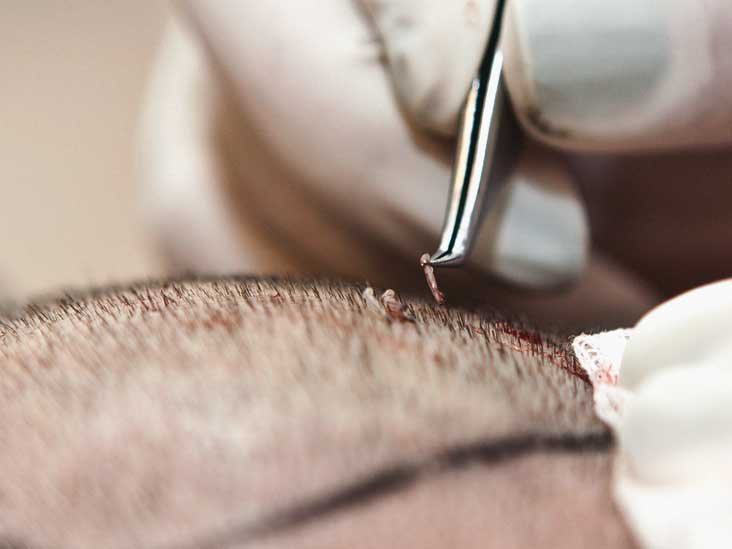
Hair transplantation is a minor surgical procedure by which the permanent hairs from the regions of scalp that never go bald, such as sides and lower back of the head(donor area) are harvested and redistributed into the areas of permanent hair loss or thinning(recipient area). FUE is the modern approach to hair transplants and is usually favoured by patients because it leaves less obvious scarring.
The procedure is done under local anaesthesia and the patients are conscious and can converse with the surgical team during the operation.
After trimming the hairs, a hairline is designed according to the patients wishes and following the generally accepted guidelines. Under local anaesthesia individual follicular unit grafts (group of 1-4 hairs) are extracted from the patient’s donor area by the help of motorized punches and carefully placed into the slits created at the recipient bald area. and the hair roots are subsequently taken out manually with forceps. Slits are created in the recipient bald area and the grafts are carefully placed into the slits.
The tiny dots that occur as a result of the procedure are so small that they do not require any stitches and the scars produced are hardly noticeable unlike in the FUT technique where a linear long visible scar produced .
A FUE hair transplant procedure ensures a natural-looking appearance and the donor area in the back of the head appears mostly unchanged.
Expectations and Recovery
After the surgery, once the anaesthesia effect weans off your scalp may feel tight, heavy and uncomfortable and which can be dealt with the help of pain killers. Antibiotics and anti-inflammatory drugs also will be prescribed along with this. Most people are able to return to work 2 to 5 days after the operation.
The transplanted hairs will fall out within the first 3-4 weeks after surgery. New hairs will grow from the hair root and will be noticeable from 3-4 months after surgery and it will carry on growing. The final results of the surgery are assessed after 9-12months when the grafts are fully grown. Most patients will need concurrent medical treatment since the process of pattern hair loss is progressive and may affect the remaining hairs.
Risks and possible complications of Treatment:
As with any kind of surgery, transplants have some risks, including bleeding and infection. The other complicatons are swelling in the forehead,occasionally extending down to the eyes and the nose, mild temporary shedding of the existing hairs, pain and temporary numbness, folliculitis and unnatural-looking new hair growth.